
Free Materials For ESL Teachers and Learners

English Newsroom

Learn English through news articles - complete lesson plans, including articles, listening, classroom activities, quiz questions and more!

Feijoa: New Zealand’s Beloved Autumn Fruit Tradition

The feijoa, New Zealand's unofficial national fruit, fosters community spirit through generous sharing each autumn.

Try this article at a different level?

Β 

In New Zealand, the feijoa has become the unofficial national fruit, even though it originally comes from South America. Unlike the kiwi, which is well-known and exported worldwide, the feijoa is not native to New Zealand and can also be found in places like California and Canberra. Still, no other country loves this unique fruit as much as New Zealanders do. The feijoa, also called pineapple guava, is green and oval-shaped, and it has a strong smell that some people love while others don’t.

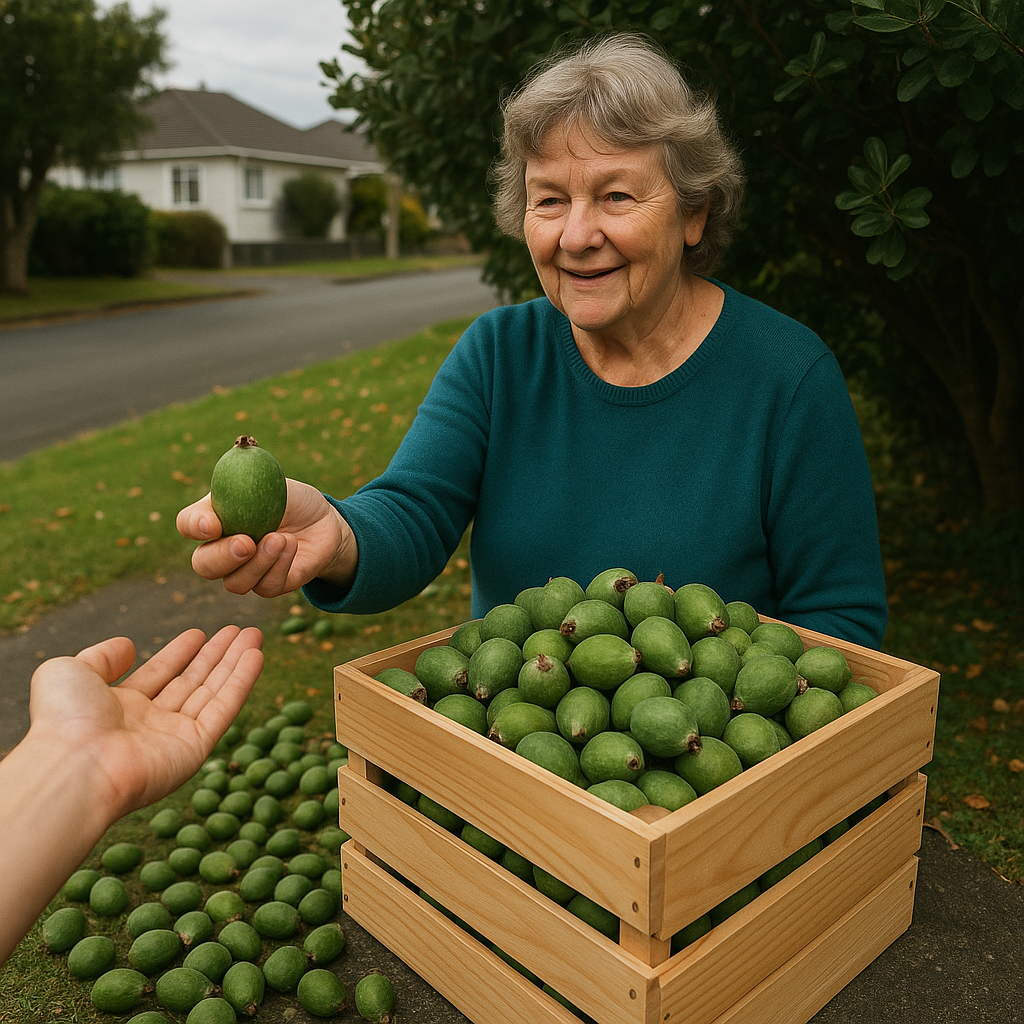
One reason the feijoa is so popular in New Zealand is that it is plentiful during the autumn months. When the fruit falls from the trees, it creates a sweet-smelling carpet in people’s backyards. Many locals pick up these fallen fruits and share them with their neighbors, friends, and even strangers. This tradition of giving away feijoas has become a big part of the culture, with some people feeling proud that they have never bought the fruit from a store. Author Kate Evans has pointed out that people expect to receive feijoas for free instead of paying for them.

In suburban Wellington, Diana Ward-Pickering is a great example of this generous spirit. She has given away thousands of feijoas from her backyard trees and often leaves boxes of the fruit on her sidewalk for anyone to take. Even though she loves feijoas, she admits that she can’t eat all the fruit that grows each season. Ward-Pickering believes sharing is important, especially for those who might not be able to afford to buy the fruit.

While many New Zealanders enjoy feijoas, not everyone agrees on how they taste. Some people love the unique flavor and texture, while others think it tastes gritty or sour. This difference in opinion can even be seen in families, like with Ward-Pickering’s daughter, who doesn’t like the fruit at all. For New Zealanders living abroad, feijoas often bring back fond memories of their childhood, making them want to find the fruit even when they are far from home.

Original news source: New Zealand’s unofficial fruit is the feijoa, not the kiwi. And part of the fun is in giving it away (AP News)

🎧 Listen:

Slow

Normal

Fast

πŸ“– Vocabulary:

1unofficialNot officially recognized or established
2exportedSent goods to another country for sale
3nativeOriginally from a particular place
4plentifulExisting in large amounts; abundant
5traditionA custom or belief passed down through generations
6generousWilling to give and share with others
7affordTo have enough money to pay for something
8textureThe feel or consistency of a surface or substance
9grittyHaving a rough or grainy feel
10sourHaving a sharp, acidic taste
11opinionA personal view or belief about something
12abroadIn or to a foreign country
13fondHaving a strong liking or affection for something
14uniqueBeing the only one of its kind; special
15cultureThe way of life, especially the customs and beliefs, of a particular group of people

Group or Classroom Activities

Warm-up Activities:

– CHARADES
Instructions: Divide the class into small groups. Each group will take turns acting out different aspects or characteristics of the feijoa fruit, its culture, or related traditions without speaking, while the other groups guess what they are portraying.

– NEWS SUMMARY
Instructions: In pairs, students will summarize the article in 3-4 sentences, focusing on the main points about the feijoa’s significance in New Zealand. Afterward, each pair will share their summary with the class.

– OPINION POLL
Instructions: Pose the question, “Do you think sharing food like feijoas is important in building community?” Students will walk around the classroom and ask 5 classmates for their opinions, recording their answers. Then, they will discuss the results in small groups.

– MIND MAP
Instructions: On the whiteboard, draw a central circle with “Feijoa” written in it. In small groups, students will brainstorm and add related words, ideas, and cultural aspects surrounding the feijoa, creating a mind map as they share their thoughts.

– HEADLINE CREATION
Instructions: Students will work in pairs to create a catchy headline for an article about the feijoa in New Zealand. They should consider the unique aspects of the fruit and its cultural significance. Afterward, pairs will share their headlines with the class for feedback.

πŸ€” Comprehension Questions:

1. Where does the feijoa originally come from, and where else can it be found besides New Zealand?
2. Why do New Zealanders have a special connection to the feijoa compared to other countries?
3. What happens to the feijoas when they fall from the trees during autumn?
4. How do people in New Zealand typically share feijoas with others?
5. Who is Diana Ward-Pickering, and what does she do with her feijoas?
6. What are some different opinions about the taste of feijoas among New Zealanders?
7. How do feijoas affect the memories of New Zealanders living abroad?
8. Why might some people feel proud about never buying feijoas from a store?
Go to answers ⇩

🎧✍️ Listen and Fill in the Gaps:

In New (1)______, the feijoa has become the unofficial (2)______ fruit, even though it originally comes from South America. Unlike the kiwi, which is well-known and exported worldwide, the feijoa is not native to New Zealand and can also be found in places like California and Canberra. Still, no other country loves this unique fruit as much as New Zealanders do. The feijoa, also called (3)______ guava, is green and oval-shaped, and it has a strong smell that some (4)______ love while others don’t.

One reason the feijoa is so popular in New Zealand is that it is plentiful during the (5)______ months. When the fruit falls from the trees, it (6)______ a sweet-smelling carpet in people’s backyards. Many (7)______ pick up these fallen fruits and share them with their neighbors, friends, and even strangers. This tradition of giving away (8)______ has become a big part of the culture, with some people feeling proud that they have never bought the fruit from a store. Author Kate Evans has pointed out that people (9)______ to (10)______ feijoas for free instead of paying for them.

In (11)______ Wellington, Diana Ward-Pickering is a great example of this generous spirit. She has given away thousands of feijoas from her backyard trees and often leaves boxes of the fruit on her sidewalk for anyone to take. Even though she loves feijoas, she admits that she can’t eat all the fruit that grows each season. Ward-Pickering (12)______ sharing is important, especially for those who might not be able to afford to buy the fruit.

While many New Zealanders enjoy feijoas, not everyone agrees on how they (13)______. Some people love the unique flavor and texture, while others think it tastes (14)______ or sour. This difference in opinion can even be seen in families, like with Ward-Pickering’s daughter, who doesn’t like the fruit at all. For New Zealanders living abroad, feijoas often (15)______ back fond memories of their (16)______, making them want to find the fruit even when they are far from home.
Go to answers ⇩

πŸ’¬ Discussion Questions:

Students can ask a partner these questions, or discuss them as a group.

1. What is your favorite fruit and why do you like it?
2. How would you feel if you could only eat one type of fruit for the rest of your life?
3. Do you think sharing food with neighbors is important? Why or why not?
4. What is a tradition in your culture that you enjoy?
5. How do you feel about trying new foods that have unusual flavors?
6. Do you like the idea of picking fruit from trees in your backyard? Why?
7. Have you ever had a fruit that you didn’t like? What was it and why didn’t you like it?
8. What is a food that reminds you of your childhood?
9. How would you feel if you moved to a new country and couldn’t find your favorite foods?
10. Do you think it’s better to buy fruit from a store or to get it for free from friends? Why?
11. What is a food-sharing tradition that you think should be more common?
12. How do you feel about the taste of foods that are considered β€œacquired tastes”?
13. Do you think it’s important for people to have a connection to their local food culture? Why?
14. What is a fruit or vegetable that you think should be more popular in your country?
15. How would you feel if someone gave you a lot of a fruit you didn’t like? What would you do?

Individual Activities

πŸ“–πŸ’­ Vocabulary Meanings:

Match each word to its meaning.

Words:
1. unofficial
2. exported
3. native
4. plentiful
5. tradition
6. generous
7. afford
8. texture
9. gritty
10. sour
11. opinion
12. abroad
13. fond
14. unique
15. culture

Meanings:
(A) The way of life, especially the customs and beliefs, of a particular group of people
(B) A personal view or belief about something
(C) Sent goods to another country for sale
(D) In or to a foreign country
(E) To have enough money to pay for something
(F) Existing in large amounts; abundant
(G) Having a strong liking or affection for something
(H) The feel or consistency of a surface or substance
(I) Having a rough or grainy feel
(J) A custom or belief passed down through generations
(K) Not officially recognized or established
(L) Originally from a particular place
(M) Having a sharp, acidic taste
(N) Willing to give and share with others
(O) Being the only one of its kind; special
Go to answers ⇩

πŸ”‘ Multiple Choice Questions:

1. What is the unofficial national fruit of New Zealand?
(a) Feijoa
(b) Kiwi
(c) Apple
(d) Mango

2. Where does the feijoa originally come from?
(a) Australia
(b) Africa
(c) Europe
(d) South America

3. What is another name for the feijoa?
(a) Dragon fruit
(b) Passion fruit
(c) Pineapple guava
(d) Star fruit

4. During which season is the feijoa plentiful in New Zealand?
(a) Winter
(b) Autumn
(c) Spring
(d) Summer

5. Who is mentioned as a generous person sharing feijoas in suburban Wellington?
(a) Kate Evans
(b) A local farmer
(c) A store owner
(d) Diana Ward-Pickering

6. What do many New Zealanders expect regarding feijoas?
(a) To buy them at the store
(b) To receive them for free
(c) To grow them themselves
(d) To import them from abroad

7. How do some people in New Zealand feel about the taste of feijoas?
(a) They have mixed opinions
(b) Everyone loves it
(c) It is universally disliked
(d) It is only popular with tourists

8. What do feijoas remind New Zealanders living abroad of?
(a) Their favorite vacation
(b) Popular tourist spots
(c) Fond memories of childhood
(d) Traditional holidays

Go to answers ⇩

πŸ•΅οΈ True or False Questions:

1. Feijoas are scarce in New Zealand during the autumn months.
2. Diana Ward-Pickering is not known for sharing thousands of feijoas from her backyard.
3. Opinions on the taste of feijoas are unanimously loved by New Zealanders, with none disliking it.
4. The feijoa originally comes from South America.
5. For New Zealanders living abroad, feijoas often remind them of their adulthood.
6. Unlike the kiwi, the feijoa is not exported worldwide.
7. The feijoa is considered New Zealand’s unofficial national fruit.
8. Many New Zealanders have a tradition of giving away feijoas to friends and neighbors.
Go to answers ⇩

πŸ“ Write a Summary:

Write a summary of this news article in two sentences.
Check your writing now with the best free AI for English writing!





Writing Questions:

Answer the following questions. Write as much as you can for each answer.
Check your answers with our free English writing assistant!

1. Why is the feijoa considered the unofficial national fruit of New Zealand?
2. What are some places outside of New Zealand where feijoas can be found?
3. How do New Zealanders usually share feijoas with others?
4. What does Diana Ward-Pickering do with the feijoas from her backyard?
5. How do opinions about the taste of feijoas differ among people in New Zealand?

βœ… Answers

πŸ€”βœ… Comprehension Question Answers:

1. Where does the feijoa originally come from, and where else can it be found besides New Zealand?
The feijoa originally comes from South America and can also be found in places like California and Canberra.

2. Why do New Zealanders have a special connection to the feijoa compared to other countries?
New Zealanders have a special connection to the feijoa because it is plentiful during the autumn months, and they have a cultural tradition of sharing the fruit with neighbors and friends.

3. What happens to the feijoas when they fall from the trees during autumn?
When the feijoas fall from the trees during autumn, they create a sweet-smelling carpet in people’s backyards.

4. How do people in New Zealand typically share feijoas with others?
People in New Zealand typically share feijoas by picking them up from the ground and giving them away to neighbors, friends, and even strangers, often leaving boxes of the fruit out for anyone to take.

5. Who is Diana Ward-Pickering, and what does she do with her feijoas?
Diana Ward-Pickering is a resident of suburban Wellington who has given away thousands of feijoas from her backyard trees and often leaves boxes of the fruit on her sidewalk for people to take.

6. What are some different opinions about the taste of feijoas among New Zealanders?
Some New Zealanders love the unique flavor and texture of feijoas, while others think they taste gritty or sour.

7. How do feijoas affect the memories of New Zealanders living abroad?
For New Zealanders living abroad, feijoas often bring back fond memories of their childhood, making them want to find the fruit even when they are far from home.

8. Why might some people feel proud about never buying feijoas from a store?
Some people might feel proud about never buying feijoas from a store because it reflects their commitment to the tradition of sharing the fruit for free within their community.
Go back to questions ⇧

πŸŽ§βœοΈβœ… Listen and Fill in the Gaps Answers:

(1) Zealand
(2) national
(3) pineapple
(4) people
(5) autumn
(6) creates
(7) locals
(8) feijoas
(9) expect
(10) receive
(11) suburban
(12) believes
(13) taste
(14) gritty
(15) bring
(16) childhood
Go back to questions ⇧

πŸ“–πŸ’­βœ… Vocabulary Meanings Answers:

1. unofficial
Answer: (K) Not officially recognized or established

2. exported
Answer: (C) Sent goods to another country for sale

3. native
Answer: (L) Originally from a particular place

4. plentiful
Answer: (F) Existing in large amounts; abundant

5. tradition
Answer: (J) A custom or belief passed down through generations

6. generous
Answer: (N) Willing to give and share with others

7. afford
Answer: (E) To have enough money to pay for something

8. texture
Answer: (H) The feel or consistency of a surface or substance

9. gritty
Answer: (I) Having a rough or grainy feel

10. sour
Answer: (M) Having a sharp, acidic taste

11. opinion
Answer: (B) A personal view or belief about something

12. abroad
Answer: (D) In or to a foreign country

13. fond
Answer: (G) Having a strong liking or affection for something

14. unique
Answer: (O) Being the only one of its kind; special

15. culture
Answer: (A) The way of life, especially the customs and beliefs, of a particular group of people
Go back to questions ⇧

πŸ”‘βœ… Multiple Choice Answers:

1. What is the unofficial national fruit of New Zealand?
Answer: (a) Feijoa

2. Where does the feijoa originally come from?
Answer: (d) South America

3. What is another name for the feijoa?
Answer: (c) Pineapple guava

4. During which season is the feijoa plentiful in New Zealand?
Answer: (b) Autumn

5. Who is mentioned as a generous person sharing feijoas in suburban Wellington?
Answer: (d) Diana Ward-Pickering

6. What do many New Zealanders expect regarding feijoas?
Answer: (b) To receive them for free

7. How do some people in New Zealand feel about the taste of feijoas?
Answer: (a) They have mixed opinions

8. What do feijoas remind New Zealanders living abroad of?
Answer: (c) Fond memories of childhood
Go back to questions ⇧

πŸ•΅οΈβœ… True or False Answers:

1. Feijoas are scarce in New Zealand during the autumn months. (Answer: False)
2. Diana Ward-Pickering is not known for sharing thousands of feijoas from her backyard. (Answer: False)
3. Opinions on the taste of feijoas are unanimously loved by New Zealanders, with none disliking it. (Answer: False)
4. The feijoa originally comes from South America. (Answer: True)
5. For New Zealanders living abroad, feijoas often remind them of their adulthood. (Answer: False)
6. Unlike the kiwi, the feijoa is not exported worldwide. (Answer: True)
7. The feijoa is considered New Zealand’s unofficial national fruit. (Answer: True)
8. Many New Zealanders have a tradition of giving away feijoas to friends and neighbors. (Answer: True)
Go back to questions ⇧

How about these other Level 3 articles?

Online
Class
Writing
Coach
β˜• 컀피 3μž” &
무료 ν”Όλ“œλ°±! πŸŽ“
β˜• 컀피 3μž” & 무료 ν”Όλ“œλ°±! πŸŽ“

X

[100% 온라인] λž­μ»€μŠ€ν„° λŒ€ν•™κ΅ μ˜μ–΄ 연ꡬ μ°Έμ—¬μž λͺ¨μ§‘
λ³„λ„μ˜ μ°Έκ°€λΉ„ 없이 영ꡭ λŒ€ν•™ 연ꡬ에 도움도 μ£Όμ‹œκ³ , 무료 μ˜μ–΄ μ‹€μ „ μ—°μŠ΅κ³Ό ν”Όλ“œλ°±λ„ λ°›μ•„λ³΄μ„Έμš”!

영ꡭ λž­μ»€μŠ€ν„° λŒ€ν•™κ΅(Lancaster University)μ—μ„œ ν•œκ΅­μΈ μ˜μ–΄ ν•™μŠ΅μžλΆ„λ“€μ„ λŒ€μƒμœΌλ‘œ μƒˆλ‘œμš΄ 연ꡬ ν”„λ‘œμ νŠΈλ₯Ό μ§„ν–‰ν•©λ‹ˆλ‹€. μ „ κ³Όμ • 온라인으둜 μ§„ν–‰λ˜μ–΄ μ–΄λ””μ„œλ“  νŽΈν•˜κ²Œ μ°Έμ—¬ν•˜μ‹€ 수 μžˆμŠ΅λ‹ˆλ‹€. μ—¬λŸ¬λΆ„μ˜ μ†Œμ€‘ν•œ μ°Έμ—¬λ‘œ ν•œκ΅­μΈμ˜ μ˜μ–΄ μ‚¬μš© 방식을 μ•Œμ•„λ³΄λŠ” ν₯미둜운 연ꡬ가 μ™„μ„±λ©λ‹ˆλ‹€.

🎁 μ°Έμ—¬ ν˜œνƒ:
– 원어민 μ—°κ΅¬μ›κ³Όμ˜ 1:1 νšŒν™” μ—°μŠ΅
– μ‹€μ „ μ˜μž‘ μ—°μŠ΅ & λ§žμΆ€ν˜• μ˜μ–΄ ν”Όλ“œλ°± 리포트
– 컀피 κΈ°ν”„ν‹°μ½˜ 총 3μž” μ„ λ¬Ό! (첫 μ„Έμ…˜ ν›„ 1μž”, λ§ˆμ§€λ§‰ μ„Έμ…˜ μ™„λ£Œ ν›„ 2μž” 더 λ“œλ €μš”! β˜•β˜•)

πŸ“… μ°Έμ—¬ 방식: 총 2회의 온라인 μ„Έμ…˜ (Zoom 등을 이용, 각 μ„Έμ…˜λ‹Ή μ•½ 60~80λΆ„ μ†Œμš”) λ§ν•˜κΈ°μ™€ μ“°κΈ° ν™œλ™μ΄ μ„žμ—¬ μžˆμ–΄ λΆ€λ‹΄ 없이 즐겁게 μ°Έμ—¬ν•˜μ‹€ 수 μžˆμŠ΅λ‹ˆλ‹€.

βœ… λŒ€μƒ: μ˜μ–΄ μ‹€λ ₯에 상관없이 μ°Έμ—¬λ₯Ό ν¬λ§ν•˜λŠ” 18μ„Έ 이상 ν•œκ΅­μΈ λˆ„κ΅¬λ‚˜

Feedback