


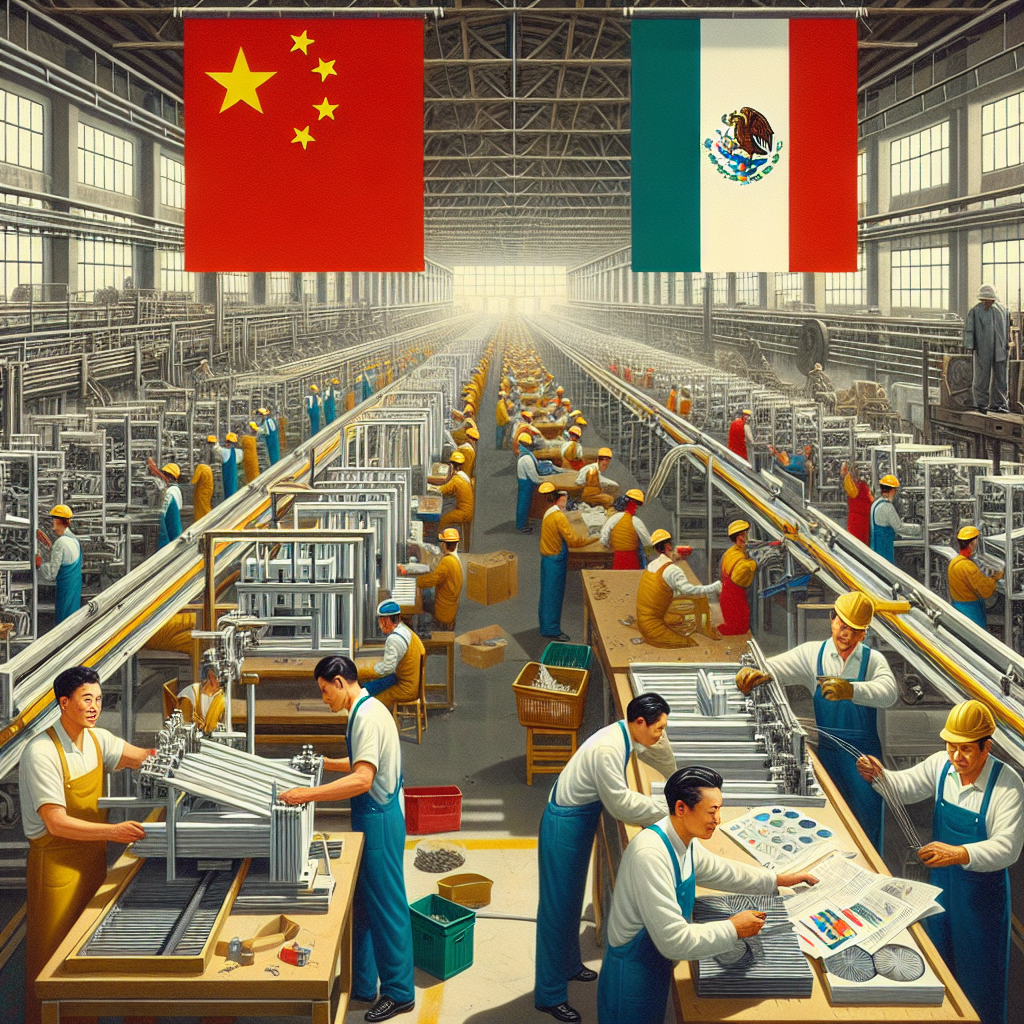
Chinese companies are using Mexico as a strategic location to gain access to the US market and bypass tariffs and sanctions imposed on Chinese goods. One such company is Man Wah Furniture, which has established a manufacturing plant in Monterrey, Mexico, with Chinese capital. The move to Mexico allows Chinese firms to save on shipping costs and produce goods that are considered Mexican, thus avoiding US tariffs. The trend of Chinese companies relocating to Mexico is providing a boost to the Mexican economy, with total exports rising by 5.8% in 2021. This trend shows no signs of slowing down, with announcements of capital investment in Mexico increasing rapidly. The interest of Chinese companies in Mexico is expected to continue due to the ongoing trade war between the US and China. Mexico's strategic position between the two superpowers has made it the US's main trading partner, replacing China. In addition to Chinese companies, US firms are also setting up facilities in Mexico as part of the nearshoring trend. However, caution is urged regarding Mexico's involvement in the US-China geopolitical struggle. Some experts argue that Mexico needs to develop a strategy to navigate this triangular relationship. Despite the tensions, some remain optimistic about the nearshoring trend and believe that Mexico can take advantage of it. The key advantage for Mexico in these challenging times of global trade is its proximity to the US market.
Original news source: How Chinese firms are using Mexico as a backdoor to the US (BBC)
🎧 Listen:
📖 Vocabulary:
Group or Classroom Activities
Warm-up Activities:
– News Summary
Instructions: In pairs, students will read the article and write a concise summary of the main points. They should focus on capturing the key information and presenting it in a clear and organized manner. Afterward, each pair will share their summaries with the class.
– Opinion Poll
Instructions: Divide the class into small groups. Each group will come up with a question related to the article and create a quick opinion poll. They will then go around the class, asking their question to different students and recording their responses. Afterward, they will present their findings to the class and discuss the different opinions.
– Vocabulary Pictionary
Instructions: Write a list of key vocabulary words from the article on the board. In pairs, one student will choose a word and try to draw it while the other student guesses what word it is. They should try to use the specific vocabulary words from the article. After a set time, switch roles and continue the game.
– Keyword Hangman
Instructions: Choose a few key words from the article and write the number of letters for each word on the board, using dashes. Students will take turns guessing letters to try and uncover the word. If a letter is correct, it will be filled in the corresponding position. If a letter is incorrect, a body part of the hangman will be drawn on the board. The goal is to uncover the word before the hangman is completed.
– Pros and Cons
Instructions: In small groups, students will discuss the pros and cons of Chinese companies using Mexico as a strategic location. They should consider the economic benefits, the impact on trade relationships, and any potential challenges or risks. Each group will then present their findings and engage in a class discussion.
🤔 Comprehension Questions:
🎧✍️ Listen and Fill in the Gaps:
companies are using Mexico as a strategic location to gain access to the US market and bypass tariffs and sanctions imposed on Chinese goods. One such is Man Wah , which has a manufacturing plant in Monterrey, Mexico, with Chinese capital. The move to Mexico allows Chinese firms to save on shipping costs and produce goods that are considered Mexican, thus US tariffs. The trend of Chinese relocating to Mexico is providing a boost to the Mexican economy, with total exports by 5.8% in 2021. This trend shows no signs of slowing down, with announcements of capital in Mexico increasing rapidly. The interest of Chinese companies in Mexico is expected to continue due to the ongoing war between the US and China. Mexico's strategic position between the two superpowers has made it the US's main trading , China. In addition to Chinese companies, US are also setting up facilities in Mexico as part of the nearshoring trend. However, caution is urged regarding Mexico's involvement in the US-China struggle. Some experts argue that Mexico to develop a strategy to navigate this triangular relationship. Despite the tensions, some remain optimistic about the nearshoring trend and believe that Mexico can take advantage of it. The key advantage for Mexico in these challenging of global trade is its to the US market.
💬 Discussion Questions:
1. What do you think about Chinese companies using Mexico as a strategic location to access the US market?
2. How would you feel if you were a Mexican worker at a manufacturing plant owned by a Chinese company? Why?
3. Do you think it is fair for Chinese companies to avoid US tariffs by producing goods in Mexico? Why or why not?
4. What is the impact of Chinese companies relocating to Mexico on the Mexican economy? Do you think this trend is positive or negative? Why?
5. How do you think the ongoing trade war between the US and China has affected Mexico's position as a trading partner with the US?
6. Do you believe Mexico should develop a strategy to navigate its relationship with both the US and China? Why or why not?
7. How do you think the nearshoring trend, with US firms setting up facilities in Mexico, will impact the Mexican economy?
8. What challenges do you think Mexico may face in its involvement in the US-China geopolitical struggle? How can they overcome these challenges?
9. Do you think Mexico can take advantage of the nearshoring trend? Why or why not?
10. How important do you think proximity to the US market is for Mexico's success in global trade? Why?
11. What other countries do you think could benefit from the nearshoring trend? Why?
12. How do you think the nearshoring trend could impact job opportunities in both Mexico and the US?
13. What are some potential risks or drawbacks of Chinese companies using Mexico as a strategic location? How can these risks be mitigated?
14. How do you think the US-China trade war has affected global trade dynamics overall?
15. Do you think the nearshoring trend will continue to grow in the future? Why or why not?
Individual Activities
📖💭 Vocabulary Meanings:
Click a dot next to a word, then click the dot next to its meaning to draw a line connecting them.
Words
Meanings
🔡 Multiple Choice Questions:
🕵️ True or False Questions:
📝 Write a Summary:
Write a summary of this news article in two sentences.
Check your writing now with the best free AI for English writing!