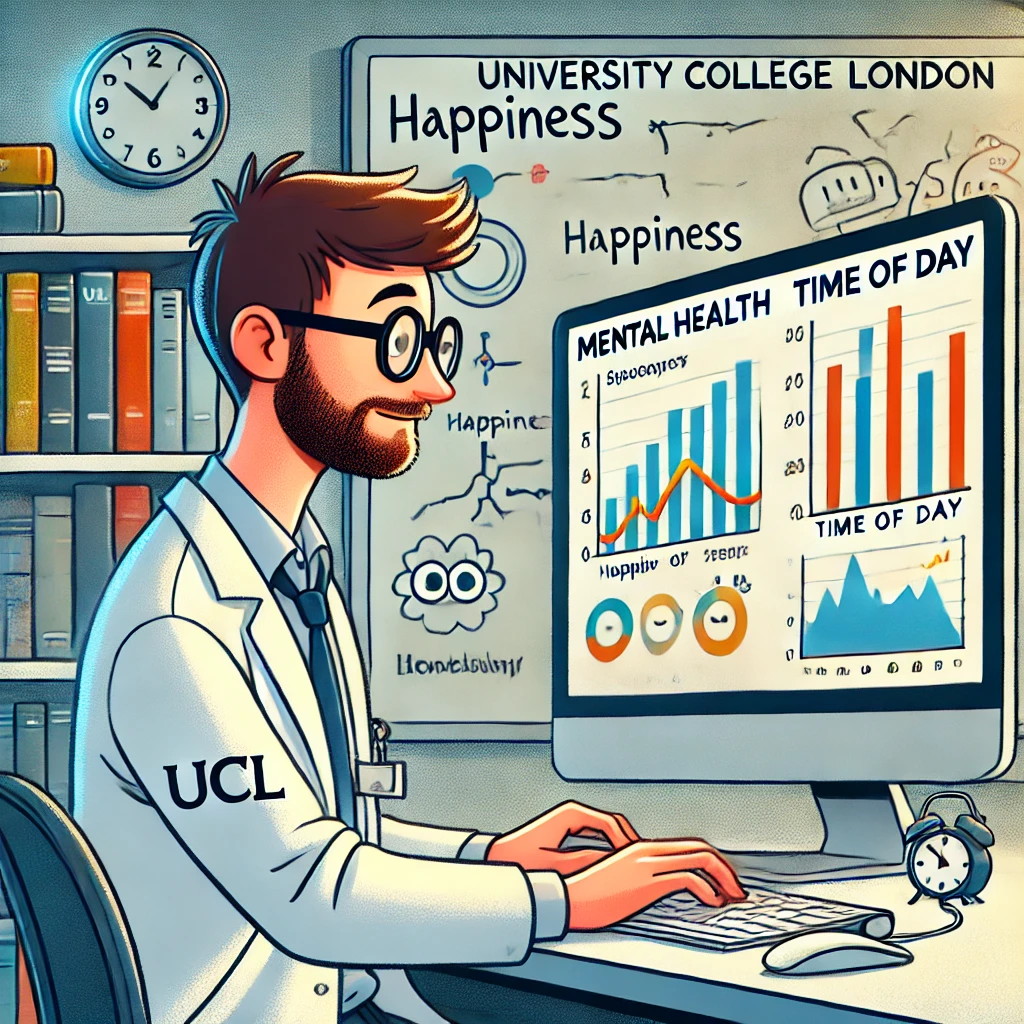
A recent study conducted by researchers at University College London (UCL) has revealed interesting insights into the relationship between mental health and the time of day. The research indicates that individuals generally experience better mental wellbeing in the morning, while their mood tends to decline as the day progresses, reaching its lowest point around midnight. This study is notable for being one of the most extensive investigations into how mental health varies throughout the day, taking into account factors such as the day of the week and seasonal changes.
The researchers aimed to understand how different times of day affect various aspects of mental health, including happiness, life satisfaction, and feelings of loneliness. They analyzed data collected from the UCL Covid-19 social study, which involved nearly one million survey responses from approximately 50,000 adults over a two-year period. Participants answered questions about their emotional states, such as their happiness levels and overall satisfaction with life, allowing the researchers to draw meaningful conclusions from the data.
Findings from the study indicated that happiness and life satisfaction were generally higher on Mondays and Fridays compared to Sundays, with Tuesdays also showing elevated happiness levels. Interestingly, the study found no significant differences in feelings of loneliness across the days of the week. Additionally, seasonal variations were observed, with individuals reporting lower levels of depressive symptoms and higher levels of happiness during the spring, summer, and autumn compared to winter.
Despite the study's comprehensive nature, the researchers noted that it was observational and could not definitively establish causation. They acknowledged that the timing of when participants completed their surveys might have influenced the results. For instance, individuals who felt better in the morning might have been more inclined to respond to the survey at that time. The researchers emphasized the need for further studies to validate these findings and account for potential biases.
Dr. Feifei Bu, one of the researchers, highlighted the implications of the study for mental health services. If the observed patterns are confirmed, it could be beneficial for mental health support systems to consider the time of day when individuals seek help. This could lead to a more responsive approach, ensuring that resources are available during periods when mental health needs fluctuate, particularly during late-night hours when individuals may be feeling their worst.
Original news source: Scientists find that things really do seem better in the morning (The Guardian)
🎧 Listen:
📖 Vocabulary:
Group or Classroom Activities
Warm-up Activities:
– CHARADES
Instructions: Divide the class into small groups. Each group will take turns acting out different aspects related to the article, such as "mental health," "happiness," "midnight," or "survey." The other groups will guess what they are acting out without using any words.
– OPINION POLL
Instructions: Pose statements based on the findings of the article, such as "I believe my mental health improves in the morning" or "I feel lonelier on Sundays." Students will walk around the classroom, asking their peers to agree or disagree. After gathering opinions, discuss the results as a class.
– HEADLINE CREATION
Instructions: Ask students to create catchy headlines for the article that highlight its main findings. They should think creatively and come up with multiple options before sharing their favorites with the class.
– THINK-PAIR-SHARE
Instructions: Pose a thought-provoking question related to the article, such as "How does your daily routine affect your mental health?" Students will think about their responses, pair up with a partner to discuss their ideas, and finally share their insights with the larger group.
– SYNONYM CHALLENGE
Instructions: Provide students with key vocabulary from the article (e.g., "mental health," "happiness," "loneliness," "satisfaction"). In pairs, they will come up with as many synonyms as possible for each word. Afterward, they can share their lists with the class for further discussion.
🤔 Comprehension Questions:
The primary focus of the study was to understand the relationship between mental health and the time of day, specifically how different times of day affect aspects such as happiness, life satisfaction, and feelings of loneliness.
The researchers collected data from the UCL Covid-19 social study, which involved nearly one million survey responses from approximately 50,000 adults over a two-year period.
Happiness and life satisfaction were generally higher on Mondays and Fridays compared to Sundays, with Tuesdays also showing elevated happiness levels.
Spring, summer, and autumn were associated with lower levels of depressive symptoms and higher levels of happiness compared to winter.
The researchers cautioned against drawing definitive conclusions because the study was observational and could not establish causation. They acknowledged that the timing of when participants completed their surveys might have influenced the results.
The timing of survey responses might have influenced the results by affecting who felt inclined to respond at certain times, such as individuals who felt better in the morning being more likely to complete the survey then.
According to Dr. Feifei Bu, if the observed patterns are confirmed, mental health support systems could benefit from considering the time of day when individuals seek help, ensuring resources are available during periods when mental health needs fluctuate, particularly during late-night hours.
The researchers aimed to understand various aspects of mental health, including happiness, life satisfaction, and feelings of loneliness, in relation to different times of day.
🎧✍️ Listen and Fill in the Gaps:
A recent study conducted by researchers at University College London (UCL) has revealed interesting insights into the relationship between mental health and the time of day. The research indicates that individuals generally experience better mental wellbeing in the morning, while their mood tends to decline as the day , its lowest point around midnight. This study is for being one of the most extensive investigations into how mental health varies throughout the day, taking into account factors such as the day of the week and changes. The researchers aimed to understand how different times of day affect various aspects of mental health, including happiness, life satisfaction, and feelings of loneliness. They analyzed data collected from the UCL Covid-19 social , which involved nearly one million survey responses from approximately 50,000 adults over a two-year . Participants answered questions about their emotional states, such as their happiness levels and overall satisfaction with life, allowing the researchers to draw meaningful conclusions from the data. Findings from the study indicated that happiness and life satisfaction were generally higher on Mondays and Fridays compared to , with Tuesdays also showing happiness levels. Interestingly, the study found no significant differences in of loneliness across the days of the week. Additionally, seasonal variations were observed, with individuals reporting lower levels of depressive and higher levels of happiness during the spring, summer, and autumn compared to winter. Despite the study's comprehensive nature, the researchers noted that it was observational and could not definitively establish causation. They acknowledged that the timing of when participants their might have influenced the results. For instance, individuals who felt better in the morning might have been more to respond to the survey at that time. The researchers emphasized the need for further studies to validate these findings and account for potential biases. Dr. Bu, one of the researchers, highlighted the implications of the study for mental services. If the observed patterns are confirmed, it could be beneficial for mental health support systems to the time of day when individuals seek help. This could lead to a more responsive approach, ensuring that resources are available during periods when mental health needs fluctuate, particularly during late-night hours when individuals may be feeling their worst.
💬 Discussion Questions:
1. What is your personal experience with your mood changing throughout the day?
2. How would you feel if you had to complete important tasks at night, knowing that your mood might be at its lowest?
3. Do you think certain times of the day are better for creative work? Why or why not?
4. What is a typical routine you follow in the morning that helps improve your mental wellbeing?
5. How do you think seasonal changes impact your mood and mental health?
6. Do you like the idea of mental health services being adjusted based on the time of day? Why or why not?
7. How would you feel if you were asked to participate in a survey about your emotional state regularly?
8. Do you think people are more honest about their mental health in the morning or at night? Why?
9. What is a strategy you use to maintain a positive mood throughout the day?
10. How do you think social activities on certain days of the week influence overall happiness?
11. Do you believe that people's mood can be significantly affected by external factors like weather or daylight? Why or why not?
12. How would you feel if mental health resources were more available during late-night hours?
13. Do you think it’s important for researchers to consider the time of day when studying mental health? Why?
14. What is a time of day when you feel most productive, and how does it affect your mental health?
15. How do you think cultural differences might affect the relationship between time of day and mental health?
Individual Activities
📖💭 Vocabulary Meanings:
Click a dot next to a word, then click the dot next to its meaning to draw a line connecting them.
Words
Meanings
🔡 Multiple Choice Questions:
🕵️ True or False Questions:
📝 Write a Summary:
Write a summary of this news article in two sentences.
Check your writing now with the best free AI for English writing!