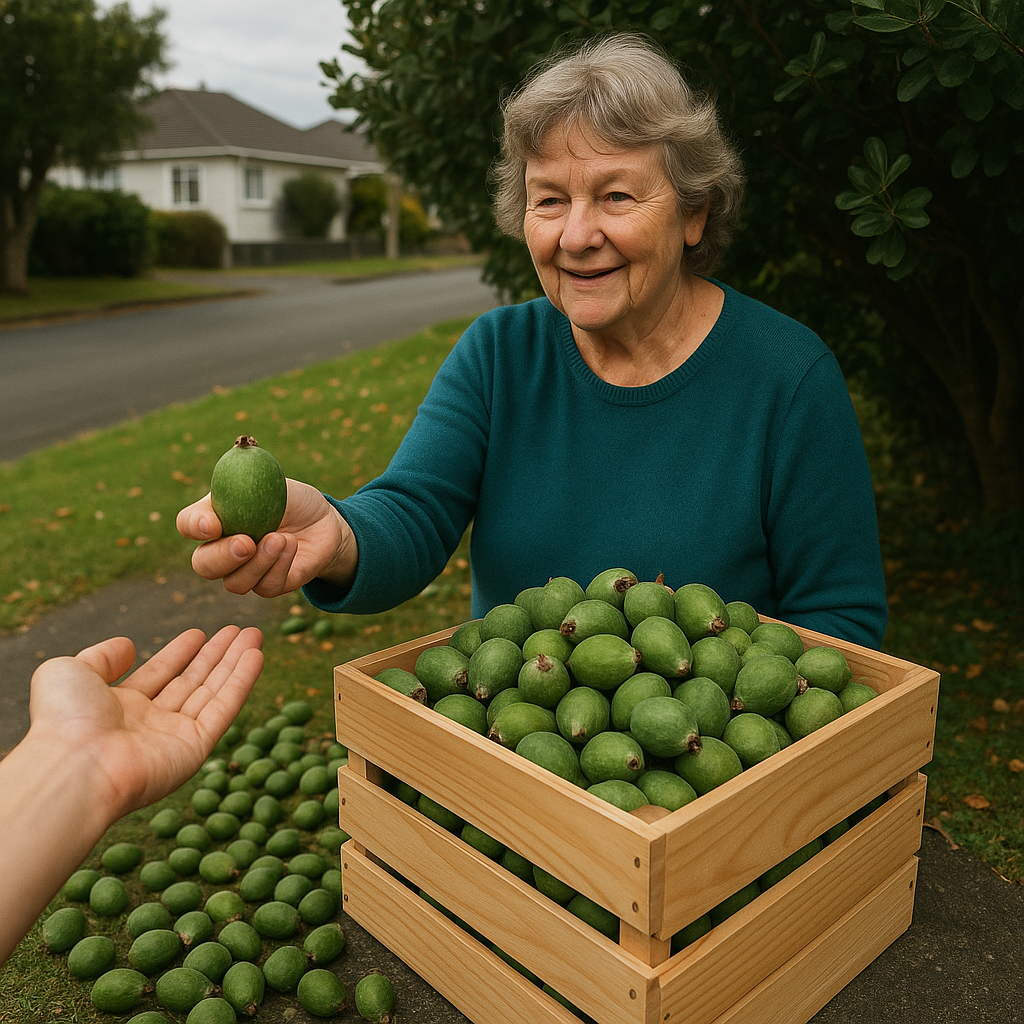
In New Zealand, people love a fruit called feijoa. It comes from South America, but New Zealanders think of it as their special fruit. Unlike the kiwi fruit, feijoas are not sold much in other countries because they don't last long. Every year, when feijoas are ready to eat, people in New Zealand get very excited. They feel a strong connection to this fruit.
Feijoas are shared a lot in New Zealand. When they fall from trees, people pick them up and give them to friends, neighbors, and even strangers. Many people never have to buy feijoas because they get them for free. This sharing makes people feel close and happy. Some people, like a lady named Diana, give away lots of feijoas from their gardens to others, showing kindness and community spirit.
Original news source: New Zealand’s unofficial fruit is the feijoa, not the kiwi. And part of the fun is in giving it away (AP News)
🎧 Listen:
📖 Vocabulary:
Group or Classroom Activities
Warm-up Activities:
– CHARADES
Instructions: Students will take turns acting out the word "feijoa" without speaking. The rest of the class will guess what they are acting out. This helps with vocabulary recognition and encourages non-verbal communication.
– VOCABULARY PICTIONARY
Instructions: Divide the class into small groups. Each group will draw a picture of a feijoa or related concepts (like sharing or community) on the board while the other groups guess the word. This activity enhances vocabulary understanding through visual representation.
– OPINION POLL
Instructions: Ask students if they have ever tried a feijoa or if they would like to try it. They will raise their hands to indicate their opinion. Afterward, students can share why they feel that way, helping them practice speaking in English.
– MIND MAP
Instructions: On the board, write "Feijoa" in the center. Students will take turns adding words or phrases related to feijoas (like "New Zealand," "fruit," "sharing") around it. This helps with vocabulary building and organization of ideas.
– PASS THE STORY
Instructions: Start a story about a feijoa tree in New Zealand. Each student adds one sentence to the story as it goes around the room. This encourages creativity and practice in sentence structure while reinforcing vocabulary from the article.
🤔 Comprehension Questions:
People in New Zealand love feijoas.
The feijoa fruit comes from South America.
Feijoas are not sold much in other countries because they don't last long.
People in New Zealand feel very excited when feijoas are ready to eat.
When feijoas fall from trees, people pick them up and share them.
A lady named Diana gives away feijoas from her garden.
Sharing feijoas makes people feel close and happy.
🎧✍️ Listen and Fill in the Gaps:
In New , people love a fruit called . It comes from South America, but New Zealanders think of it as their special fruit. Unlike the kiwi fruit, feijoas are not sold much in other countries because they don't last long. Every year, when feijoas are to eat, people in New Zealand get very . They feel a strong connection to this fruit. Feijoas are shared a lot in New Zealand. When they fall from trees, people pick them up and give them to , neighbors, and even strangers. Many people never to buy feijoas because they get them for free. This sharing makes people feel close and . Some people, like a lady named Diana, give away lots of feijoas from their gardens to others, showing and community spirit.
💬 Discussion Questions:
1. What is your favorite fruit?
2. Do you like to share your food with friends? Why?
3. How would you feel if someone gave you a special fruit?
4. Do you think it is nice to share things with others? Why or why not?
5. What is a fruit you think is very special?
6. How do you feel when you eat your favorite fruit?
7. Do you like to try new fruits? Why?
8. What would you do if you found a fruit on the ground?
9. Do you think it is fun to pick fruit from trees? Why?
10. How would you feel if you had a big garden with lots of fruits?
11. Do you think sharing makes people happy? Why or why not?
12. What is a nice thing you can do for your friends?
Individual Activities
📖💭 Vocabulary Meanings:
Click a dot next to a word, then click the dot next to its meaning to draw a line connecting them.
Words
Meanings
🔡 Multiple Choice Questions:
🕵️ True or False Questions:
📝 Write a Summary:
Write a summary of this news article in two sentences.
Check your writing now with the best free AI for English writing!